Key Takeaways
- SEO is about visibility. It is the strategic process of making your website easy for search engines to find, understand, and recommend to users.
- User intent is the new king. In 2026, ranking isn’t just about keywords; it’s about answering the specific why behind a user’s search.
- AI and Search are merging. To stay visible, you must optimize for both traditional search engines (SEO) and AI-driven answer engines (AEO/GEO).
Search Engine Optimization (SEO) is the practice of improving your website to increase its visibility in organic (unpaid) search results on engines like Google and Bing. By optimizing your content, technical setup, and authority, you ensure that when someone searches for what you offer, your site appears at the top.
Why SEO is Your Best Friend in 2026
In 2026, the digital world is noisier than ever. Organic search still brings in 53% of all website traffic, which is far more than paid ads. If your business isn’t visible on the first page, you are essentially invisible to billions of daily searchers.
| Feature | SEO (Organic) | SEM (Paid) |
| Cost | Free per click | Pay per click |
| Speed | Takes 6–12 months | Immediate |
| Trust | High credibility | Lower (users know it’s an ad) |
| Longevity | Compounding results over time | Stops when the budget ends |
How Search Engines Actually Work (The Library Analogy)
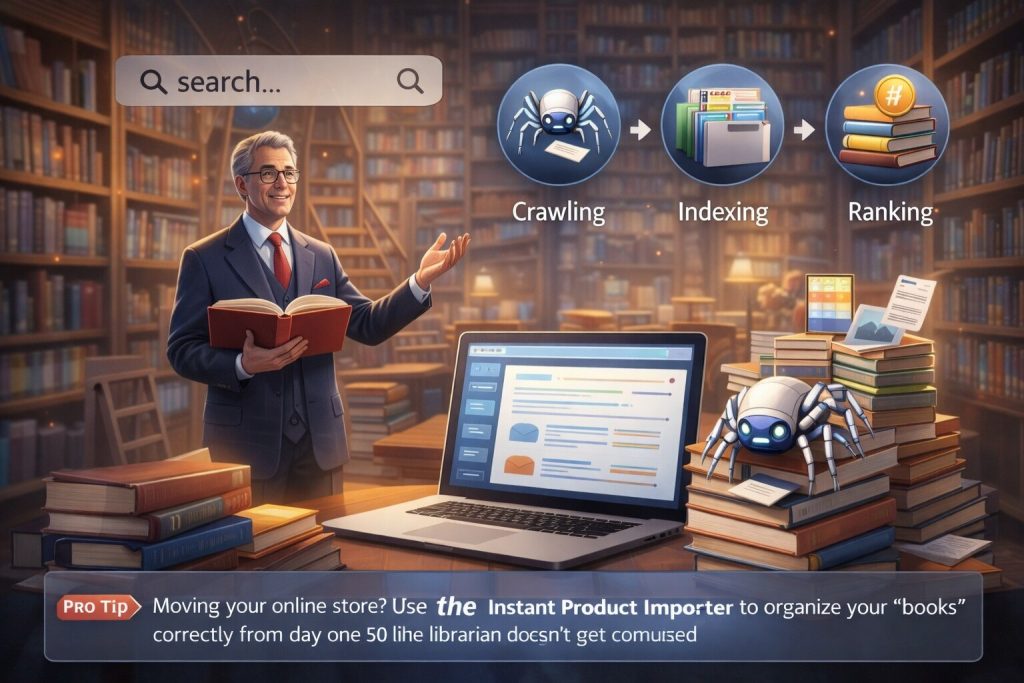
Think of a search engine as the world’s most advanced librarian. Every day, billions of new “books” (web pages) are published. The librarian has three main jobs:
- Crawling: Automated “spiders” follow links across the web to find new content.
- Indexing: The librarian reads the content and stores it in a massive digital library (the index).
- Ranking: When you ask a question, the librarian looks through the index and pulls out the most helpful, trustworthy books to show you first.
Pro Tip: If you are moving an online store, use the Instant Product Importer to ensure your “books” are organized correctly from day one so the librarian doesn’t get confused.
The 3 Pillars of a Winning SEO Strategy
To rank #1, your website needs to be strong in three specific areas.
1. On-Page SEO (The Content)
On-page SEO is everything you do on your website to help search engines understand your pages. This includes choosing the right keywords and writing helpful content.
- Keyword Research: You must find the exact phrases your audience uses.
- Search Intent: Are they looking for information, or are they ready to buy?.
- Structure: Use clear H1, H2, and H3 tags so users and bots can scan your page easily.
Technical Insight: For 2026, “Information Gain” is critical. Google rewards content that adds new value rather than just repeating what is already online.
2. Technical SEO (The Engine)
Technical SEO ensures your site is fast, secure, and mobile-friendly. If your site takes too long to load, users will leave, and Google will demote you.
Chart Description: Page Speed vs. Bounce Rate Imagine a bar chart where the x-axis is “Loading Time (Seconds)” and the y-axis is “Bounce Rate (%).” As the loading time moves from 1 second to 5 seconds, the bounce rate bar shoots up significantly. This visualizes why speed is a ranking factor.
Helpful Tools for Speed:
- imagebulking: This tool shrinks your image sizes automatically, making your site fly and improving your Core Web Vitals.
- altgeneratorai: Use this for quick, automatic image descriptions (alt text) to help visually impaired users and search bots understand your visuals.
3. Off-Page SEO (The Reputation)
Off-page SEO is about building authority through backlinks. When other high-quality sites link to you, it acts like a “vote of confidence”.
AEO vs. SEO: The Major 2026 Shift
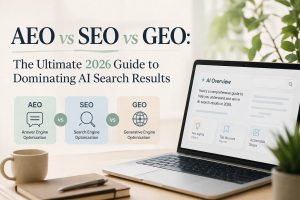
By 2026, search has evolved into Answer Engine Optimization (AEO). Instead of clicking links, users often get a direct answer from an AI summary at the top of the page.
| Feature | SEO | AEO |
| Primary Goal | Rank web pages | Provide direct AI answers |
| Content Style | Long-form, detailed | Short, structured snippets |
| Platform | Google, Bing | AI Overviews, Voice Assistants |
| Metric | Website Traffic | Direct Visibility/Citations |
To win in this new era, every section of your article should start with a clear answer statement. You can use Promptingimage to create highly detailed image descriptions that AI engines love to extract and show in visual search results.
The Power of E-E-A-T
Google’s standard for quality in 2026 is E-E-A-T: Experience, Expertise, Authoritativeness, and Trustworthiness.
- Experience: Show that you’ve actually used the product or lived the topic.
- Expertise: Prove you know what you’re talking about.
- Authority: Be the go-to source in your niche.
- Trust: Ensure your site is secure (HTTPS) and your facts are accurate.
Nearly 49% of marketers are doubling down on E-E-A-T to protect their rankings from AI disruption.
Technical FAQ
1. How long does SEO take to work? SEO is a marathon. You might see small changes in a few weeks, but it typically takes 6 to 12 months to see major results for competitive terms.
2. Is link building still important in 2026? Yes, but quality matters more than quantity. One link from a trusted industry site is worth more than a thousand spammy links.
3. What are Core Web Vitals? These are specific speed and stability metrics Google uses to measure user experience. The big ones are LCP (how fast it loads), INP (how fast it responds), and CLS (how much the page jumps around).
4. Will AI replace SEO? No, AI will change SEO, but not replace it. AI needs high-quality, human-created content to learn and provide answers.