Key Takeaways
- The Maturity Shift: 2026 marks the year Google transitioned from “reactive” updates to a proactive system that prevents low-quality content from ranking in the first place.
- Discover is a Priority: The confirmed February 2026 Discover core update emphasizes local relevance, original expertise, and the death of clickbait.
- AI Efficiency Breakthrough: Google’s new TurboQuant algorithm reduces AI memory usage by 6x, meaning powerful AI models will soon run directly on your smartphone without losing quality.
What Actually Changed in the 2026 Google Algorithm?
In 2026, Google moved away from sudden “earthquake” updates that destroyed traffic overnight. Instead, it now uses a more refined, intelligence-driven system that rewards websites built on genuine expertise and long-term authority.
Rather than one massive change, Google released a series of layered improvements. These updates focused on making search results feel more stable and dominated by trustworthy sources.
| Feature | Old SEO Way (Before 2026) | New SEO Way (2026 & Beyond) |
| Content Goal | Writing for keywords and search bots. | Writing for humans and solving problems. |
| AI Content | Mass-produced, low-effort articles. | Helpful, high-quality AI-assisted work. |
| Trust Signals | Just getting backlinks. | Building a public brand and reputation. |
| Stability | Huge rankings swings every month. | Established authorities see fewer fluctuations. |
| Ranking Focus | Individual keyword targeting. | Deep expertise in an entire subject area. |
The February 2026 Discover Core Update: A Game Changer
The most important confirmed update of 2026 is the February Discover core update, which shifted how articles appear in a user’s personalized feed. This update proved that Google now treats Discover as a major traffic source that requires its own unique strategy.
Google’s goal with this update was to show users content that is timely and locally relevant. It also took a hard stand against “sensational” headlines and clickbait. To win in Discover now, you must demonstrate “topical expertise”—which means you must be a known expert in the subject you are writing about.
Why Your Discover Traffic Might Have Dropped
- Too Much Clickbait: If your headlines use “outrage framing” or curiosity hooks, you are now at higher risk.
- Lack of Originality: Simply rewriting what others have said is no longer enough to get into Discover.
- No Local Context: Google wants content that feels aligned with the user’s specific geographic context.
TurboQuant: The “Digital Cheat Sheet” for AI
TurboQuant is Google’s new AI-compression algorithm that shrinks the memory footprint of large language models (LLMs) by six times. This is a massive technical breakthrough because it allows AI models to run faster and use less power while maintaining the same high quality of answers.
To understand how this works, think of an AI model like a student taking a test. Normally, the student has to remember every single fact they’ve ever learned, which is exhausting and takes a lot of brainpower (memory). TurboQuant is like giving that student a “digital cheat sheet” (called a key-value cache) that stores the most important info in a tiny, organized shorthand.
How the Magic Happens: PolarQuant and QJL
Google uses two steps to make this happen:
- PolarQuant: Instead of using standard “square” coordinates (like “3 blocks East, 4 blocks North”), it uses “circular” coordinates (like “5 blocks at a 37-degree angle”). This takes up much less space on the computer’s chip.
- QJL (Quantized Johnson-Lindenstrauss): This is a 1-bit error-correction layer that cleans up any mistakes from the first step.
| Technical Method | What it Does | Benefit to You |
| PolarQuant | Converts data into a compact polar “shorthand”. | Reduces memory usage by 6x. |
| QJL | Uses a 1-bit trick to fix mathematical errors. | Keeps AI answers accurate and high-quality. |
| TurboQuant | Combines both for extreme compression. | Makes AI on your phone 8x faster. |
Ranking Factors That Matter Most in 2026
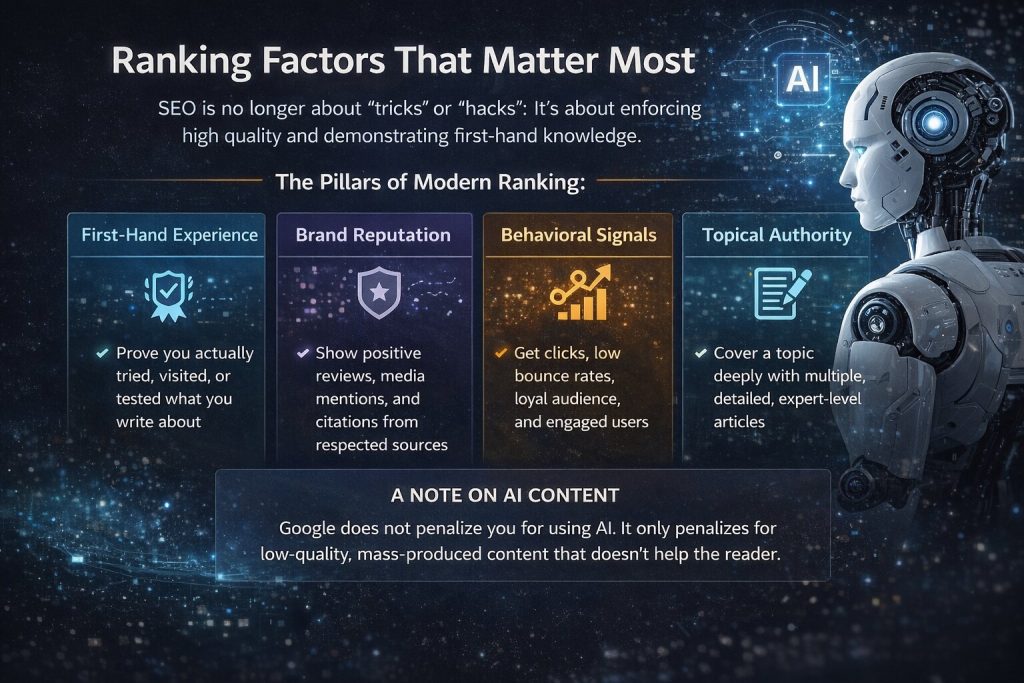
SEO is no longer about “tricks” or “hacks”; it is about enforcing high quality. If you want to rank #1 today, you must focus on Content Authenticity Signals. This means showing Google that you have first-hand knowledge of what you are talking about.
The Pillars of Modern Ranking:
- First-Hand Experience: Did you actually visit the city you’re writing about? Did you test the product?.
- Brand Reputation: Google looks at reviews, media mentions, and citations across the entire internet, not just your site.
- Behavioral Signals: If users click your link but leave immediately (bouncing), your rankings will eventually fall.
- Topical Authority: A site with 100 articles on one topic will beat a site with 1,000 articles on random topics.
A note on AI content: Google does not penalize you for using AI. It only penalizes you if the AI-generated content is low-quality, mass-produced filler that doesn’t help the reader.
How AI Overviews are Changing Your Clicks
AI Overviews (formerly SGE) provide quick answers at the top of the search page. While some people worry this will “steal” their traffic, it actually changes the type of clicks you get.
Simple, “one-answer” queries (like “What is the capital of France?”) might see fewer clicks. However, people looking for deep research, original analysis, and expert comparisons will still click through to high-quality articles. To survive this, your content must be “extractable”—meaning it’s so well-organized that AI systems can easily cite and quote you.
Chart: Speed vs. Sales (Visualization Idea)
Imagine a line graph here showing that as your page speed increases (Technical SEO), your sales conversion rate climbs sharply. This illustrates that technical foundations still matter in 2026.
Steps to Recover if Your Rankings Dropped
If you noticed a drop in traffic after a 2026 update, don’t panic and rewrite everything. Follow this disciplined diagnosis workflow:
- Check for Official Updates: Use tools like Google Search Console or the DM Cockpit Website Rank Checker to see if your drop matches an official Google announcement.
- Segment Your Traffic: Did you lose traffic in Web Search or just in Discover? These require different fixes.
- Audit for “Thin” Content: Look at the pages that dropped. Are they just summarizing what others said? If so, add original data, new examples, or expert quotes.
- Strengthen Trust Signals: Make sure your “About Us” and “Author” pages clearly show your credentials.
- Give it Time: Quality reassessments by Google can take weeks or even months. Recovery is rarely instant.
Technical FAQ
1. Is AI content safe to use for SEO in 2026? Yes! Google explicitly stated that it penalizes low-quality content, regardless of whether a human or AI wrote it. If your AI content is helpful and accurate, it can rank well.
2. What was the “February 2026 Discover Update” about? It focused on making Discover feeds more locally relevant, reducing sensational clickbait, and rewarding original expertise.
3. Do backlinks still matter for ranking? Absolutely. They remain one of the strongest signals of authority. However, a few links from trusted, high-quality sites now matter more than thousands of low-quality links.
4. How does TurboQuant affect me as a website owner? While it’s a technical AI update, it means that AI search tools (like Siri or Gemini) will become much faster and more capable on mobile devices. You should focus on making your content easy for these AI systems to read and “extract”.
For more detailed insights on managing your digital presence, explore the resources at DM Cockpit or read the latest strategy guides at ALM Corp.