Key Takeaways
- Content is the Foundation: High-quality, original content that demonstrates E-E-A-T (Experience, Expertise, Authoritativeness, and Trustworthiness) remains the most critical factor for ranking in both traditional and AI search.
- User Experience (UX) is Mandatory: Google prioritizes sites that load fast, are mobile-friendly, and provide positive behavioral signals like high “dwell time” and low “pogo-sticking.”
- Authority is Earned through Links: Backlinks from authoritative, topically relevant websites act as “votes of confidence” that significantly boost your domain’s credibility.
Understanding SEO Ranking Factors: How to Win Online
SEO ranking factors are specific, measurable signals that search engines like Google use to evaluate, score, and rank websites. They act as a digital checklist that tells search engine algorithms which pages best answer a user’s question based on relevance, authority, and user experience.
Think of SEO like organizing a giant library. Imagine you are a librarian (Google) helping a student find the best book on “Healthy Recipes.” You wouldn’t just give them any book. You would look for one that is written by a real chef (Authority), has clear pictures (UX), is updated for 2026 (Freshness), and is easy to read (Content Quality).
The XACT Framework for SEO Success
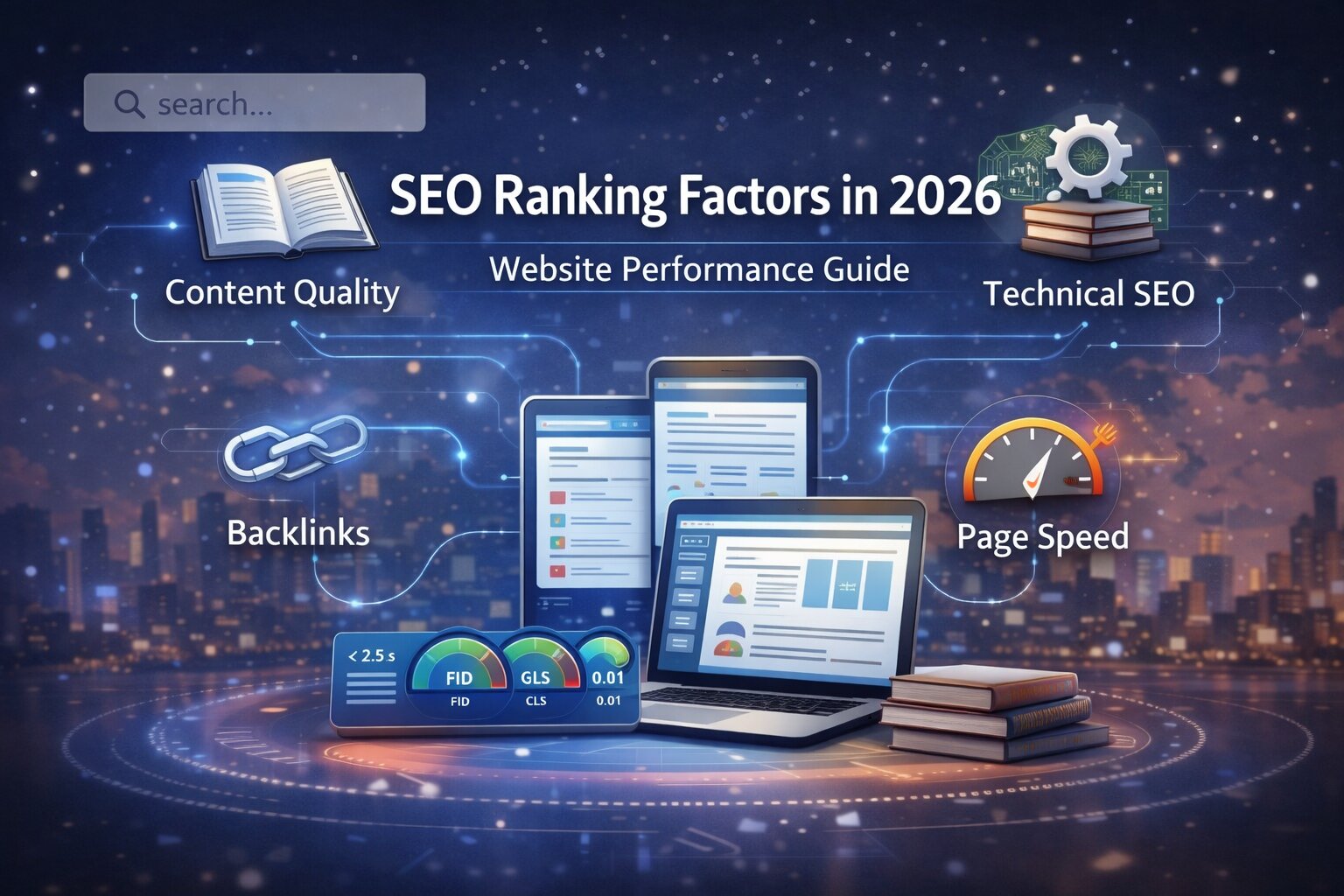
According to leading SEO experts, ranking factors can be grouped into four main pillars known as XACT.
| Pillar | Focus Area | Why it Matters |
| User Experience (X) | Speed, Layout, Mobile-Friendliness | Keeps users happy and on your site. |
| Authority (A) | Backlinks, Brand Trust, E-E-A-T | Proves your site is a leader in its field. |
| Content (C) | Relevance, Keywords, Freshness | Answers the user’s specific search query. |
| Technical SEO (T) | HTTPS, Sitemaps, Crawlability | Helps search bots find and read your pages. |
Pro Tip: If you want to move your products to a new site without a manual headache, use an Instant Product Importer to save hours of work.
1. User Experience (UX): Pleasing the Human Visitor
Google prioritizes websites that deliver positive behavioral signals such as high dwell time, low pogo-sticking, and intuitive navigation. If visitors land on your page and immediately leave (pogo-sticking), it tells Google that your page wasn’t what they were looking for.
Key UX Ranking Signals
- RankBrain & User Interaction: RankBrain is Google’s AI that looks at how people click on and interact with search results to decide which pages are most helpful.
- Core Web Vitals: These measure how fast and stable your page loads. Google wants your site to be interactive and visually stable so elements don’t jump around while loading.
- Mobile-Friendliness: Since most people search on their phones, Google uses “Mobile-First Indexing,” meaning it evaluates your mobile site before your desktop site.
- Dwell Time: This is the amount of time a user stays on your page after clicking from Google. A “long click” signals that the content was valuable.

UX Signal Comparison Table
| Factor | Ranking Impact | How to Improve It |
| Page Speed | High | Use imagebulking.com to shrink image sizes. |
| Mobile UX | High | Use a responsive design and large, readable fonts. |
| Pop-ups | Negative | Avoid intrusive ads that block the main content on mobile. |
| Safe Browsing | Medium | Ensure your site is free of malware and hacked content. |
Visual Idea: Place a chart here showing the correlation between Page Load Speed and Bounce Rate—as speed increases, bounce rate drops significantly.
2. Authority: Building Your Digital Reputation
Authority is an evaluation of your website’s overall trustworthiness and expertise, primarily measured through the quality and quantity of backlinks. Backlinks act as “votes” from other websites; the more high-quality votes you have, the more Google trusts you.
The Power of E-E-A-T
In 2026, Google leans heavily on E-E-A-T (Experience, Expertise, Authoritativeness, and Trustworthiness).
- Experience: Does the author have first-hand experience with the product or service?
- Expertise: Is the content creator a recognized expert in this field?
- Authoritativeness: Is your site the “go-to” source for this topic?
- Trustworthiness: Is the site secure (HTTPS) and transparent about its authors?
How to Boost Authority
- Quality over Quantity: One link from a site like The New York Times is worth more than 1,000 links from unknown blogs.
- Topical Authority: Consistently write about one subject to prove you are an expert.
- Social Signals: Shares on LinkedIn, Facebook, and X (Twitter) indirectly help by driving traffic and brand mentions.
To ensure your images aren’t hurting your trust scores, use altgeneratorai.com to automatically add descriptive alt text. This helps visually impaired users and improves your “Image Search” rankings.
3. Content: Writing for People and Search Engines
High-quality, relevant content is the single most important ranking factor because it directly addresses search intent. Google wants to provide the best, most comprehensive answer to a user’s question.
Content Optimization Strategies
- Keyword Placement: Include your primary keyword in the first 100 words, the H1 title, and subheadings (H2/H3).
- Semantic SEO: Use variations and synonyms (LSI keywords) to show Google you understand the “topic,” not just the “keyword.”
- Content Length: While there is no “perfect” length, longer content (usually 1,400 to 2,000+ words) tends to cover topics more deeply and rank better for complex queries.
- Multimedia: Including videos and infographics increases “time on site” and makes your content more engaging.
Formatting Checklist for Ranking
- [ ] Short Paragraphs: Max 3 sentences to keep readers engaged.
- [ ] Bullet Points: Makes information easy to scan.
- [ ] Numbered Lists: Perfect for “How-to” guides.
- [ ] Internal Links: Connect your articles to help Google crawl your site.
Pro Tip: For high-converting image descriptions that rank, check out Promptingimage.com. It helps you describe images perfectly for both AI and human readers.
4. Technical SEO: The Hidden Engine
Technical SEO ensures that search engine crawlers can access, read, and index your website without errors. If the “spiders” can’t crawl your site, you won’t rank, no matter how good your content is.
Critical Technical Factors
- HTTPS (SSL): Security is a confirmed ranking factor. Non-secure sites are often marked as “Not Secure” in browsers, killing user trust.
- XML Sitemaps: This is a map of your site that you give to Google to help it find all your pages.
- Structured Data (Schema): This is code you add to your site to help Google show “Rich Snippets” like star ratings or recipe details in search results.
- Robots.txt: This file tells search bots which parts of your site they are allowed to visit.
Technical Health Table
| Technical Element | Likelihood of Impact | Recommended Action |
| HTTPS Security | Confirmed | Install an SSL certificate today. |
| XML Sitemap | High | Submit your sitemap via Google Search Console. |
| Canonical Tags | High | Use these to prevent “duplicate content” penalties. |
| Broken Links | Medium | Use a tool to find and fix 404 errors. |
The Future of SEO: AI and Beyond
In 2026, ranking isn’t just about the “10 blue links” on page one. AI Overviews and MUM (Multitask Unified Model) are changing how results are displayed.
- AI Overviews: Google uses AI to summarize answers at the top of the page. To show up here, your content must be clear, factual, and easy for AI to parse.
- Voice Search: More people are asking questions to Alexa or Siri. Optimize for conversational “long-tail” keywords that sound like natural speech.
- Video Content: Videos are appearing more frequently in standard search results. Every blog post should consider a video companion.
Technical FAQ
1. How many ranking factors are there really? Google uses over 200 ranking factors, though some experts believe it could be thousands when considering machine learning signals.
2. Does social media directly improve my rankings? Google has stated that social shares are not a direct ranking factor. However, they help indirectly by increasing brand awareness, traffic, and the chance of earning real backlinks.
3. How often does Google change its algorithm? Google updates its algorithm thousands of times per year, though most are small. Major “Core Updates” happen a few times a year and can significantly shift rankings.
4. Is domain age a ranking factor? While Google says domain age is not a direct factor, older domains often have more backlinks and established authority, which does help them rank higher.
References & Resources: