Key Takeaways
- Quality Over Quantity: Google now uses advanced AI to reward “people-first” content and penalize mass-produced, low-effort articles.
- The Rise of Discover: The February 2026 Discover core update signals that Google is now treating Discover as a major, independent traffic source with its own quality standards.
- AI Efficiency Breakthrough: Google’s new TurboQuant algorithm reduces AI memory usage by 6x and boosts speed by 8x, making high-quality AI features faster on your phone and laptop.
In 2026, Google rankings are no longer about “tricking” an algorithm with keywords. Instead, Google has moved toward a more refined, intelligence-driven system that prevents low-quality content from ever gaining visibility. It is the year Google’s evaluation system finally matured.
The Big Shift: What Changed in 2026?
Google’s core updates in 2026 aren’t sudden “earthquakes” like they used to be. Instead, they are a series of layered improvements that focus on trust, intent, and authenticity.
| Feature | Old SEO (Pre-2026) | New SEO (2026 & Beyond) |
| Focus | Keyword repetition and backlinks | Topical authority and user satisfaction |
| Content | Mass-produced AI or generic articles | Original research and expert insights |
| Detection | Reacting to spam after it spreads | Proactive AI-driven quality filtering |
| Authority | Individual page optimization | Entity-level reputation and brand signals |
The February 2026 Discover Core Update
The most significant confirmed update of the year is the February 2026 Discover core update. This update proved that Discover is no longer just a “bonus” traffic source.
Google is now rewarding content in Discover that shows local relevance and demonstrated expertise. If you want to rank here, you must reduce clickbait and focus on in-depth, timely reporting.
TurboQuant: The New Engine Powering AI
Google recently released a breakthrough called TurboQuant. This is a compression algorithm that shrinks the memory footprint of Large Language Models (LLMs) more than six-fold.
SEO Analogy: Think of SEO in 2026 like organizing a massive library. In the past, the librarian (Google) just looked for book titles. Now, the librarian uses a “digital cheat sheet” (TurboQuant) to instantly know which books are written by real experts and which ones are just copies. This helps the librarian serve you the best book faster than ever before.
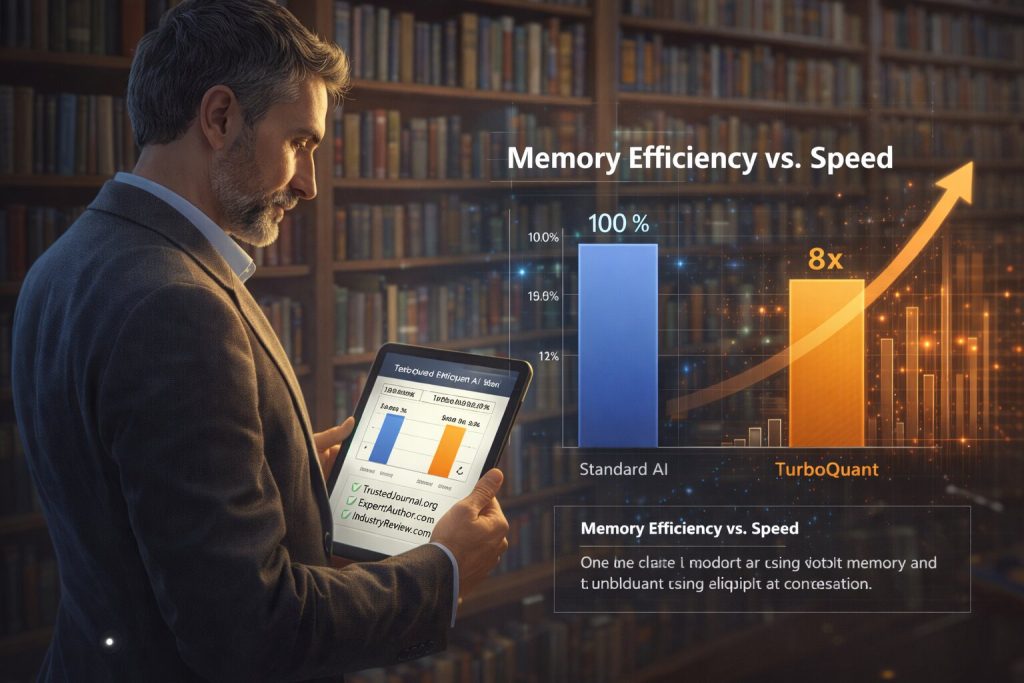
Chart Description: Memory Efficiency vs. Speed Imagine a bar chart. One bar shows “Standard AI” using 100% memory and 1x speed. The second bar shows “TurboQuant” using only 16% memory (a 6x reduction) and running at 8x speed. This efficiency allows complex AI to run directly on your smartphone.
6 Core Ranking Factors You Need to Know
Google’s ranking systems are now a complex web of systems working together to match intent. Here are the factors that carry the most weight this year:
- Content Authenticity: Articles reflecting real, first-hand experience and original research are prioritized over generic summaries.
- Entity-Level Trust: Google evaluates the reputation of the brand or author across the whole internet, including reviews and citations.
- AI Quality Filtering: The system distinguishes between helpful AI-assisted content and mass-produced filler.
- Behavioral Signals: User satisfaction—how long someone stays on a page and whether they return—acts as a massive quality indicator.
- Topical Authority: Google rewards sites that cover a subject deeply rather than those that chase random keywords.
- Link Quality: A few high-trust links from respected sources now outweigh hundreds of low-quality ones.
Industries Hit Hardest by the 2026 Updates
Not every niche was affected the same way. Google was particularly strict in areas where accuracy is vital.
| Industry | Impact of 2026 Update |
| Health & Medical | Professional credibility and accuracy became non-negotiable. |
| Finance | Transparency and brand reputation are now decisive factors. |
| Affiliate Marketing | Sites without genuine product testing saw steep declines. |
| AI Content Networks | Mass-automated production was heavily filtered out. |
| Local Businesses | Those with strong reviews and local reputations saw gains. |
How to Recover from a Ranking Drop
If your traffic fell after the latest Google algorithm update, don’t panic. Recovery is possible, but it requires substantial work.
- Confirm the Update: Use Google Search Console to see if your drop aligns with an official update window.
- Segment Your Data: Check if the drop happened in Web Search or Discover, as these require different fixes.
- Assess Quality: Ask if your pages are “ending the search.” If a user reads your page and still needs to go back to Google, your content isn’t sufficient.
- Strengthen Trust: Add clear authorship, expert reviews, and remove vague or unverified claims.
- Improve Structure: Use clear headings and put the most important facts at the top of the page for “extractability”.
Technical FAQ
What is the latest Google update in 2026? The most important confirmed change is the February 2026 Discover core update, which emphasizes local relevance and original expertise.
Is AI content safe for SEO in 2026? Yes, but only if it is helpful and accurate. Google penalizes low-quality content regardless of whether a human or AI wrote it.
Do backlinks still matter for ranking? Yes. High-quality backlinks remain one of the strongest indicators of authority and trust in 2026.
What is TurboQuant? It is a Google Research algorithm that makes AI models 6x smaller and 8x faster without losing accuracy.
Sources: DM Cockpit, ALM Corp, The Motley Fool, Ars Technica, Google Research.